
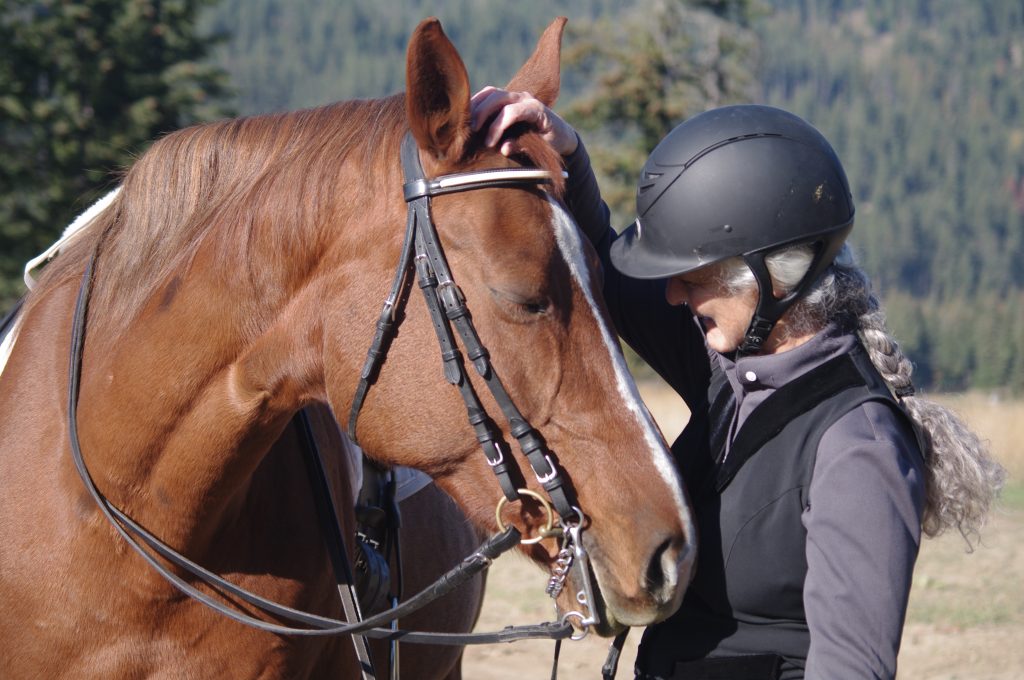
Discover Movement Language—the communication system horses naturally speak
By Chris Adderson
Creator of Movement Language and Patterns of Reciprocity™
Your horse responds to every cue. The movements are perfect. Stimulus-response. Pressure-release.
And somewhere in all that perfect conditioning... where did your horse go?
What remains is a well-trained responder. Where did the consciousness go? The curiosity? The ability to participate rather than just respond?
Let me show you what I mean.
What Horses Actually Speak
I "moved" with my four-month-old granddaughter the other day.
Her left arm was locked down and back, creating tension through her tiny body. She was fussy, working her teething toy with her mouth, unable to settle.
In that moment, I wasn't thinking about pressure and release. I was speaking Movement Language.
My consciousness through my nervous system, through my touch, was embodying a certain movement.
Not pressure—rhythm.
My movement talking to her movement. My nervous system talking to her nervous system.
She stopped fussing. Her eyes got this glazed look. She focused intensely—not with her intellect, she couldn't—but with something deeper.
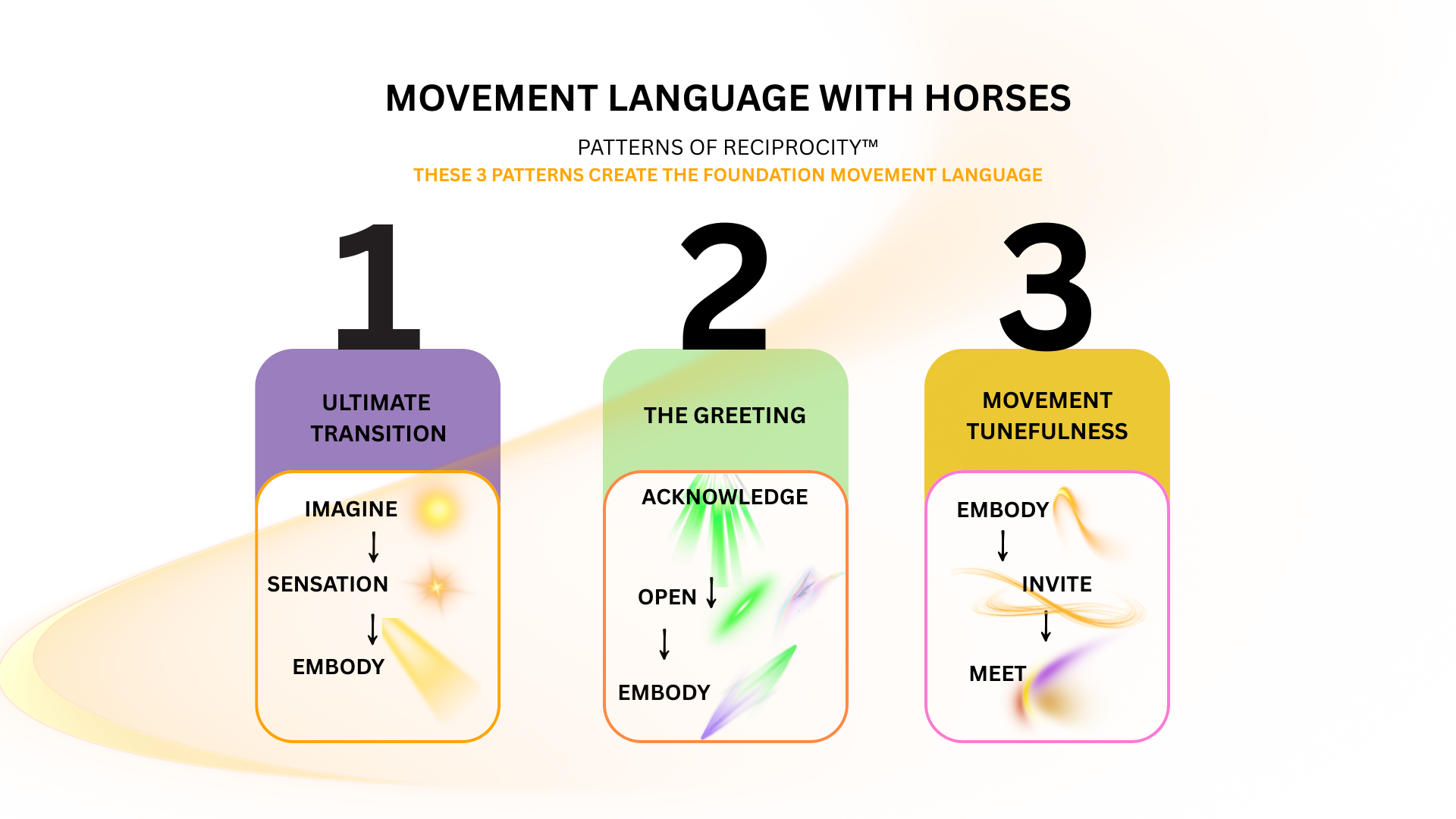
The same capacity horses have. We moved together, totally reciprocal, a dialogue through the Patterns of Reciprocity™. I used the Ultimate Transition—imagine, sensation, embody. I Greeted her constantly to see she was emotionally ready (acknowledge, open, embody). Then Movement Tunefulness—embody, invite, meet.
And she went into flow. Then into Hum.
I knew my movement was incorporated into her nervous system because we reached Hum. When you reach Hum, you know. I felt it. She felt it. She didn't intellectualize anything. It was all on the level of Movement Language.
This is exactly how your horse experiences you.
Not through the mechanics of your aids. Not through the pressure you apply or release. But through your embodied intention. Through how you organize your body. Through your consciousness flowing through your nervous system before you ever move.
Your horse's nervous system is reading yours right now—in the barn, on the ground, in the saddle. Your consciousness meeting their intelligence. The question is: are you fluent in the language they're actually speaking?
The Conversation We're Not Having
There's a conversation happening in the equestrian world right now about pressure.
When to apply it. How much to use. Whether "pressure and release" is the foundation of all horse communication. The definition.
But the conversation itself reveals how deeply we misunderstand what horses actually need from us.
Because here's what I've learned over 40 years of working with horses across multiple disciplines and training philosophies:
When to apply it. How much to use. Whether "pressure and release" is the foundation of all horse communication. The definition.
But the conversation itself reveals how deeply we misunderstand what horses actually need from us.
Because here's what I've learned over 40 years of working with horses across multiple disciplines and training philosophies:
Pressure isn't the problem. Release isn't the solution.
What matters is what happens in the space between.
That invisible territory where your consciousness meets your horse's intelligence. Where your nervous system speaks to theirs. Where Movement Language—the communication system horses naturally understand—creates partnership instead of compliance.
What matters is what happens in the space between.
That invisible territory where your consciousness meets your horse's intelligence. Where your nervous system speaks to theirs. Where Movement Language—the communication system horses naturally understand—creates partnership instead of compliance.
Pressure isn't the problem. Release isn't the solution.
What matters is what happens in the space between.
What We Lost in the Mechanics
Traditional methods teach us to think in stimulus and response.
Apply pressure. Horse responds. Release pressure. Horse learns.
It's mechanical. Measurable. It feels like progress.
But watch what actually happens with a horse trained this way.
The movements might be there. Every cue produces a response. Stimulus-response. Pressure-release. Cue-behavior.
The horse has learned: when I feel this, I do that.
And somewhere in all that perfect conditioning... the horse disappeared.
What remains is a well-trained responder. An automaton moving through sequences. A programmed response.
Where did the consciousness go? The curiosity? The ability to participate in communication rather than just respond to it?
This isn't a robotic thing—"I put this pressure here, you move there, I release." That's not communication. That's programming.
Your horse is capable of something far more profound.
The horse disappeared. What remains is a well-trained responder. An automaton.
Movement Language: What Horses Actually Speak
Your horse doesn't experience pressure the way you think they do.
They experience your embodied intention before you ever apply an aid.
They read your energy before you give a cue.
They sense your internal state—your tension, your clarity, your doubt, your confidence—through how you occupy space and move through it.
This is where true lightness lives.
True lightness emerges from the infinitely small.
Not in soft hands or quiet legs. Not in how little pressure you can get away with.
True lightness emerges from the infinitely small. From the unspoken signals your body reveals before you even realize you're communicating.
Your muscle tensions. The quality of your breath. The energy that shifts in your body before each action.
Your horse reads this invisible language with remarkable precision.
This is Movement Language—the communication system horses naturally speak. The primal expression, the integral language of all beings that flows through consciousness and the nervous system, through embodied intention and rhythmic resonance.
What the classical masters called "tact" or "feel"... what they described through metaphor because they didn't have other language for it... modern neuroscience is finally beginning to map.
And horses? Horses have been demonstrating it all along.
Your horse reads this invisible language with remarkable precision.
The Three Patterns That Matter More Than Pressure
1. The Space Between Thought and Action
What happens between your thought and your embodied expression?
Most riders have a gap here.
The confusion in your body—the disconnect between what you intend and what you actually embody—this is what your horse responds to.
Not your aids. Your state of being.
The Ultimate Transition pattern—Imagine, Sensation, Embody—teaches you to close this gap. To make the translation from thought to embodied action conscious and clear.
This is the work. Building a language that's precise. Maintaining clear intentions in all circumstances. Creating what I call a "just language"—one that's fair, accurate, honest in its communication.
When I was moving with my grandchild, I used the Ultimate Transition. Imagine the sensation in my body to know what I wanted to do. Get clear on the embodied quality before moving. Then express it through rhythm, not pressure.
Horses need the same clarity.
2. Reciprocity: The Reciprocal Conversation
This is where everything traditional training misses.
Your horse isn't waiting to be told what to do. They're capable of participating. Of offering. Of meeting you in genuine communication where both of you contribute.
This is intelligent dialogue. Your consciousness meeting the intelligence of your horse.
Not domination. Not submission. Shared resonance. Both of you adjusting, responding, creating something together that neither could create alone.
When you Greet—Acknowledge, Open, Embody—you create an opening for your horse to be a conscious partner, not just a responder.
You acknowledge where their attention is. You open to more information. You embody your clarity without judgement.
And they can choose to be with you.
This is the conversation that becomes possible when you speak their language.
3. Embodied Intention
This is the shape you create within your body. The energetic quality of your presence. The clarity of what you're inviting before you ever move.
It's what filters through your consciousness before it becomes action.
When you Embody clearly, your horse can Meet you. They can participate. They can say yes or ask for more time or show you what they need.
This isn't wishful thinking. This is practical biomechanics meets embodied communication.
Your horse's nervous system is reading yours. Their mirror neurons are firing in response to your internal state. The quality of your embodiment—how precisely your body expresses your intention—determines whether they understand the invitation.
This is the Pattern of Reciprocity™: Movement Tunefulness—Embody, Invite, Meet.
Not a command. An invitation to dialogue.
Still abstract?
Let me show you exactly what this looks like with a real horse, in challenging conditions, when everything conventional training tells you to do would fail.
What This Looks Like in Practice
I was working with a mare recently on the beginnings of Spanish walk.
She's sensitive. It was pouring rain. Thunder rolling through. Her attention kept pulling toward the barn door.
In a pressure-based system, this would be the moment to "correct" her attention. Redirect. Add pressure until she focuses on me.
I stayed with the Patterns.
I stayed present.
I embodied what I was inviting. She looked out the door. I Greeted her—acknowledged where her attention was, opened to more information, embodied my clarity without judgement.
She came back to me. Not because I made her. Because she could read my internal state. My calm. My focus. My invitation without demand.
Then her body got crooked.
In mechanical thinking, this is when you'd use your aids to straighten her. Apply pressure until the body is where you want it.
I didn't. I kept my Place of Potential clear. I stayed with Embody, Invite, Meet. I maintained my intention without forcing it through pressure.
I let her explore in the crookedness.
This isn't about corrections. It's about: how can you organize your body to meet me in this movement?
My body stayed clear. My state of presence remained constant. And she could read that clarity.
She figured it out. She brought herself together.
She gave me an incredible gift that would have been lost if I'd interfered with mechanics and pressure.
This is what happens when you communicate in the space where the visible and invisible meet. Where your unspoken signals speak louder than any aid you could apply.
This is Movement Language in practice.
Ready to learn this language? The Movement Language Mini-Course teaches you the foundational communication system horses naturally understand.
What Science Reveals About How Horses Actually Learn
Research in equine cognition, nervous system function, and biomechanics is confirming what horses have been showing us all along.
Recent peer-reviewed studies from the University of Sussex (2016), Hokkaido University (2018), INRAE France (2025), and PLOS One (2026) demonstrate that horses read human emotional states through facial expressions, cross-modal perception, emotional contagion, and even chemosignals—they can literally smell our emotional state.[1]:  Horses are sentient beings with consciousness, emotions, and awarenessThey can read embodied intention before we apply aids They synchronize their nervous systems with ours They respond to the quality of our presence, not just our actions They can participate in two-way communication where both partners listen and respond They can self-regulate and self-organize when given the space to do so
But only if we approach them as conscious partners, not mechanical responders.
Only if we develop our own sensitivity to the unspoken signals, the subtle language, the invisible communication that matters more than any physical cue.
When I moved rhythmically with my granddaughter's arm, I wasn't applying pressure and release.
I was introducing new information into her nervous system—creating new neural pathways that had either become dormant or were not developed yet.
One nervous system talking to another nervous system.
Same with horses.
This is the subtlety and the nuanced interaction I'm talking about with the Patterns of Reciprocity™.
 NEW RESEARCH (January 2026)
A groundbreaking study published this month in PLOS One confirms horses can smell human fear and joy through chemosignals, affecting their behavior and physiology. The research made headlines in CNN: "Horses really can smell our fear, new study finds."
This is exactly what Movement Language has been teaching—horses read our internal state through channels we barely understand.
PLOS ONE Research (January 2026) - Human emotional odours
One nervous system talking to another nervous system.
Going Beyond
Mastering Unspoken Connections

This doesn't mean you never use your aids.
Or that you become passive and unclear.
It means you understand that the quality of your presence, the clarity of your embodied movement, the precision of your internal state matters more than any amount of pressure you could apply.
It means you're in constant dialogue with your horse. Reading their unspoken signals. What they understand. What they're feeling. What they need.
It means connection matters more than perfect execution.
It means the quality of presence you share creates connection that mechanical methods never can.
This is the journey inward that changes everything outward.
Learning to refine your sensitivity. Your awareness. Your ability to maintain clear intention without forcing it through pressure.
Learning to let your horse's intelligence meet your consciousness in that space where true lightness emerges.
This is Movement Language. This is what the Patterns of Reciprocity™ teach you.
How to communicate in a way that keeps your horse engaged, curious, participating.
Not programming a responder. Connecting with a conscious being.
Not programming a responder. Connecting with a conscious being.
Where Tradition Meets Science
The classical masters knew this.
They described it through metaphor and feel because they didn't have other language for it. They spoke of horses as partners in an art. They understood that true collection emerges from the horse's willing participation, not forced compliance.
Modern science is beginning to map what they intuited: Mirror neuron systems that allow horses to read our internal states Nervous system synchronization that creates shared resonance Embodied cognition that processes intention before action Reciprocal communication patterns that require both partners to listen and respond
And horses... horses have been demonstrating it all along.
When tradition and contemporary research converge—this is where the path opens.
Where we can combine the wisdom of the masters with the precision of modern understanding.
Where intuition meets evidence.
Where art meets science.
Where your consciousness meets your horse's intelligence to create something neither of you could create alone.
The question is: Are you fluent enough in your horse's language that pressure becomes mostly irrelevant?
Your Horse Has Been Speaking This Language All Along
The question isn't whether pressure has a place in horse communication.
The question is: Are you fluent enough in your horse's language that pressure becomes mostly irrelevant?
When you can communicate through embodied intention...
When your internal state speaks before your aids do...
When you can maintain clear presence in all circumstances...
When you can participate in genuine reciprocity where both of you contribute...
Pressure becomes what it should be: the absolute last, and addition for refinement, not the foundation.
Your horse is already speaking Movement Language.
With other horses. With their environment. With you, whether you realize it or not.
They're reading your unspoken signals. Your breath. Your movement. Your internal state.
The only question is whether you're ready to develop the sensitivity, the awareness, the presence to speak this language consciously instead of accidentally.
To open this path where true lightness lives.
The question isn't whether pressure has a place in horse communication.
The question is: Are you fluent enough in your horse's language that pressure becomes mostly irrelevant?
The Patterns That Make It Possible
Movement Language isn't vague philosophy. It's a precise system built on the Patterns of Reciprocity™. These are just 3 of the 7 Patterns:
These aren't techniques to apply. They're languages to speak.
They're how you become fluent in the communication system horses naturally understand.
They're how one nervous system learns to talk to another nervous system with precision, clarity, and respect for the consciousness you're engaging.
When I helped my grandchild become unstuck through the Patterns, reaching that state where she went into flow and then into Hum—that's exactly what we're working toward with our horses.
That moment when the reciprocal dialogue flows. When both partners are contributing. When you reach Hum together.
An Invitation
I've spent four decades weaving together professional dance training, the wisdom of classical dressage, the precision of kinesiology, and the grounded science of nervous system awareness.
Movement Language emerged from that intersection—a communication system that bridges the poetic and the practical. The felt sense and the tangible. The ancient wisdom and the contemporary understanding.
It's not a method to apply. It's a language to remember.
Your horse already speaks it. They've been fluent since birth.
The question is whether you're ready to remember it yourself.
To move from pressure to presence.
From mechanics to consciousness.
From programming responders to partnering with sentient beings.
This is the work that transforms everything.
Not because it gives you new techniques, but because it illuminates the language that has always existed between you and your horse.
The language of movement. Of embodied intention. Of nervous system to nervous system.
The language horses speak with remarkable precision, waiting for us to become fluent enough to truly listen.
Ready to Learn Movement Language?
The Movement Language Mini-Course teaches you the foundational communication system horses naturally understand. Where the invisible becomes visible. Where your consciousness learns to meet your horse's intelligence.
Scientific References
[1] Smith, A.V., Proops, L., Grounds, K., Wathan, J., & McComb, K. (2016). Functionally relevant responses to human facial expressions of emotion in the domestic horse (Equus caballus). Biology Letters, 12(2), 20150907.
https://doi.org/10.1098/rsbl.2015.0907
[2] Nakamura, K., Takimoto-Inose, A., & Hasegawa, T. (2018). Cross-modal perception of human emotion in domestic horses (Equus caballus). Scientific Reports, 8(1), 8660.
https://doi.org/10.1038/s41598-018-26892-6
[3] Cozzi, A., Mota-Rojas, D., Hernández-Ávalos, I., Verduzco-Mendoza, A., & Domínguez-Oliva, A. (2025). Chemosignaling in equids: Behaviour and biochemistry of olfactory communication. Applied Animal Behaviour Science, 106476.
https://www.inrae.fr/en/news/joy-fear-horses-sense-our-emotions
[4] Jardat, P., Destrez, A., Damon, F., Tanguy-Guillo, N., Lainé, A.S., & Lansade, L. (2026). Human emotional odours influence horses' behaviour and physiology. PLOS ONE, 21(1), e0337948.
https://doi.org/10.1098/rsbl.2015.0907
About Movement Language
Movement Language is the communication system that horses naturally speak—a precise framework for embodied communication developed by Chris Adderson through the integration of classical dressage, professional dance training, kinesiology, and nervous system science.
Unlike pressure-based methods that create mechanical responses, Movement Language teaches you to communicate through embodied intention and precision movement, rhythmic resonance, and reciprocal dialogue—the same language horses use with each other and read in every interaction.
The Patterns of Reciprocity™ (Ultimate Transition, Movement Tunefulness, Greeting, and others) provide the precise framework for becoming fluent in this language, transforming the horse-human relationship from command-and-response to genuine partnership.
Want to go deeper? Explore the For The Horse Community, read Going Beyond, schedule a consultation to discuss your journey with Movement Language.