
Movement Education Course
Laminitis recovery doesn't end when the acute crisis passes. Diet, trim, and time address the structural damage—but the movement patterns your horse developed during pain don't resolve on their own. This course teaches you exactly what to do next.
Laminitis Recovery:
Help Your Horse Move Freely Again
A systematic movement education program that teaches horse owners how to restore flowing, functional movement after laminitis—addressing the critical gap conventional protocols miss.
What You'll Learn
• The 4-step systematic protocol for movement pattern recovery
• How to develop your eye to see dysfunctional patterns
• How to develop your feel to assess readiness and progress
• Spine lengthening techniques (The Triad and progressive protocols)
• Balance improvement methods to shift weight off the forehand
• Movement Language application using Patterns of Reciprocity™
Instructor: Chris Adderson
Creator of Movement Language with Horses and the Patterns of Reciprocity™ framework • 40+ years classical dressage experience • Professional dance training (embodied awareness and movement biomechanics) • Bachelor of Kinesiology, University of Calgary • Published author: Going Beyond: Mastering Unspoken Connections
This course provides movement education to support your horse's recovery alongside veterinary care and proper farrier work. It is not medical treatment or rehabilitation therapy.
"I LOVE your rehab movement lectures!"
Eleanor Kellon, VMD · Veterinary Nutritionist, Mad Barn · Owner, ECIR Group
Your Horse Survived Laminitis.
Now Help Them Move Freely Again.
The systematic protocol for restoring flowing, functional movement—
not just absence of lameness
You've Done Everything Right
Your vet managed the acute crisis. Your farrier adjusted the trim. You overhauled the diet. You gave your horse time to heal.
The acute inflammation resolved. The rotation stabilized. X-rays show structural improvement.
But your horse still isn't moving freely.
They're still stilted. Still short-strided. Still landing toe-first or flat. Still heavy on the forehand.
The acute crisis passed—but the movement patterns remain broken.
Your vet says "give it more time." Your farrier says "the structures need to rebuild." And you're watching your horse move in ways that make you hold your breath.
Because somewhere deep down, you know: time alone won't fix this.
What Conventional Laminitis Protocols Miss
Standard laminitis care focuses on three things:
Diet
Control sugar & starch intake
Trim
Support coffin bone alignment
Time
Wait for structures to heal
These are all necessary. None are sufficient.
Because they address the structural crisis—but they completely miss the nervous system crisis.
Pain rewires your horse's nervous system. Dysfunctional movement patterns become embedded. And those patterns don't resolve on their own—even after the pain stops.
Is This Course Right for You?
This course is for you if:
✓ Your horse survived laminitis but still isn't moving correctly
✓ You've addressed diet, trim, and management — but something's still wrong
✓ You're committed to 10–20 minutes of daily hands-on work, 2–3 times per day
✓ Your horse is stabilized — off pain medication for at least 48 hours, comfortable at rest
✓ You're ready to learn a new way of communicating with your horse through movement
This course is not for you if:
✗ Your horse is still in the acute phase or still on pain medication
✗ You're looking for someone else to do the work for you
✗ You want a quick fix or passive recovery
✗ You're not willing or able to commit to consistent daily sessions
This is owner-implemented work. You are the one who will guide your horse's recovery. I'm teaching you how. That's how it works — and that's why it works. You are with your horse every day. I'm not.
I remember the sinking feeling when my gelding became increasingly footsore as laminitis set in.
I struggled to change his diet at the boarding facility, eventually providing my own hay at my own cost. I heard conflicting opinions about how his feet should be trimmed and spent hours researching options, agonizing over whether I was making the best choices. I experimented with different boots until I found a combination that made him more comfortable.
After all that, when he appeared stable, he continued to move with short, stilted steps. He was girthy when saddled and reluctant to accept contact with the bit.
He no longer moved with the long, floating strides he had before laminitis—even though x-rays didn't show significant changes to his feet.
I struggled to help him regain his promise as a dressage horse and felt he might never recover from this setback. I felt I was failing him. I wondered if we'd ever get back to the way we were.
When I found this course, it was very exciting to see how quickly my horse came back together...and to know resources were there if I got stuck.
Karen Gerhart, PhD
Science Advisor
The Missing Protocol:
Movement Pattern Recovery
During laminitis, your horse's nervous system rewires itself around pain.
They learn to move in ways that minimize hurt:
• Landing toe-first to avoid heel pain
• Shifting weight to the forehand to protect the hinds
• Shortening stride to reduce concussion
• Bracing through the spine to create stability
• Moving asymmetrically to favor one side
These patterns saved your horse during the acute crisis.
But they destroy long-term soundness.
Your horse's body healed.
Their movement patterns didn't.
And this is what conventional protocols don't address:
The systematic rebuilding of movement patterns after nervous system rewiring.
How It Works
The 4-Step Recovery System
Not through force. Through communication.
Using Movement Language—the embodied communication system horses naturally understand—you'll systematically recover the movement patterns laminitis destroyed. This is how your horse goes from stilted and dysfunctional to flowing, biomechanically correct gaits.
Step 1
Develop Your Eye
Most people notice gross lameness but miss the subtle restrictions, compensations, and dysfunctional patterns that matter most. This course changes that.
You'll learn to see where your horse holds tension, how they're compensating, what's improving and what's not, and the difference between pain and difficulty.
Your eye becomes your primary diagnostic tool.
Step 2
Develop Your Feel
Your hands become assessment and healing tools.
At rest, you'll learn to feel where tension is held in poll, thoracic, and lumbar areas—how structures connect and move, what releases and what stays stuck.
In motion, you'll learn to feel the quality of movement through The Triad, whether you're synchronized or fighting, and when to ask, when to wait, when to follow.
Your feel becomes your guidance system.
Step 3 — The Core Work
Lengthen Your Horse's Spine
This is where transformation happens.
Through systematic walk sessions (10–20 minutes, 2–3 times daily), you help your horse rediscover flowing movement. Not forcing. Not drilling. Inviting.
You'll learn the Walk Session Procedure—exactly what to do, the 13 Key Moments to Mark, and the Movement Sequence Mantra:
Forward • Open Your Poll • Lengthen Your Spine
You'll learn how to evaluate progress objectively, and when to be more assertive versus more conservative.
What this looks like in real time:
Week 1
Rigid, restricted movement
Week 3
Beginning to swing through the walk
Week 6
Flowing, functional movement with consistent heel-first landings
Step 4 — The Prevention Step
Improve Your Horse's Balance
Once flowing movement is established, we address the deeper issue: getting your horse off the forehand.
Laminitis damages the front feet. Horses compensate by loading the forehand more. This creates a vicious cycle—more weight on already-damaged structures.
The Lift teaches your horse to engage the hindquarters, lighten the forehand, and achieve true self-carriage. This is what prevents future breakdown. Lack of development of The Lift is often the root cause of navicular syndrome, suspensory damage, and other chronic lameness.
Establishment of The Lift is critical to enabling your laminitic horse to completely heal their feet and prevent future lameness.
There Is Nothing Else Like This
We researched every laminitis resource available to horse owners. Here is what exists:
• Free articles and forum advice — general information, no systematic protocol
• Single-topic lectures for $85 — one hour, focused on hoof care or diet alone
• Professional certifications at $4,850+ — designed for vets and farriers, not horse owners
• Year-long mentorships at $1,200–2,400/year — ongoing cost, no systematic movement protocol
What does not exist — anywhere — is this:
A systematic, owner-implemented movement recovery protocol that addresses what laminitis does to the nervous system — taught through the embodied communication system horses naturally understand.
That gap is why this course exists.
This course is different in three specific ways:
It addresses the nervous system, not just the structure. Diet and trim are essential. They are not sufficient. This course addresses what they leave behind.
It teaches you, the horse owner, to do this work. You are with your horse every day. You are the one who can provide the consistent, daily communication their nervous system needs to reorganize. No professional can do that for you.
It uses Movement Language. Not mechanical protocols. Not pressure-based methods. The embodied communication system your horse already understands — applied systematically to movement pattern recovery.
"I LOVE your rehab movement lectures!"
Eleanor Kellon, VMD
Veterinary Nutritionist, Mad Barn
Owner, Equine Cushing's and Insulin Resistance (ECIR) Group
Real Recovery
ZJ: From Severe Laminitis
to Fully Functional Movement
On Day 1, ZJ was rigid. Toe-first. Every step an effort.
Severe lameness. Compensatory bracing through her entire spine. The classic movement pattern of a horse whose nervous system had reorganized entirely around pain.
Her structure had survived the crisis. Her movement patterns hadn't.
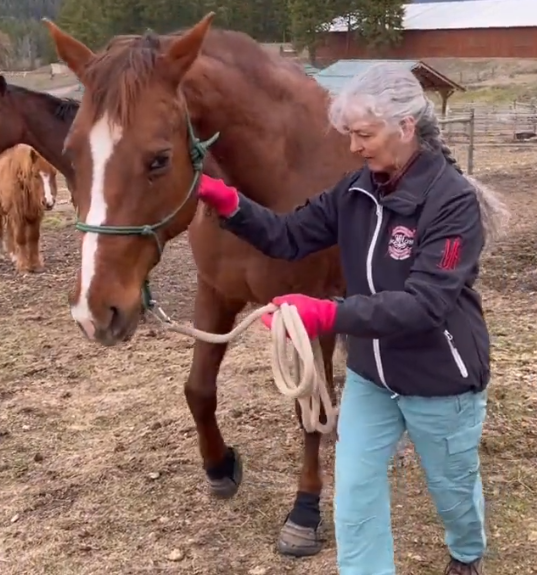
We didn't force her into better movement. We invited her nervous system to reorganize around health instead of pain. Daily sessions. Systematic. Progressive. Using the same protocols you'll learn in this course.
Here's what happened:
Day 3
The brace began releasing.
Early spine-lengthening work at rest. First signs of swing returning — the first indication that the nervous system was ready to reorganize.
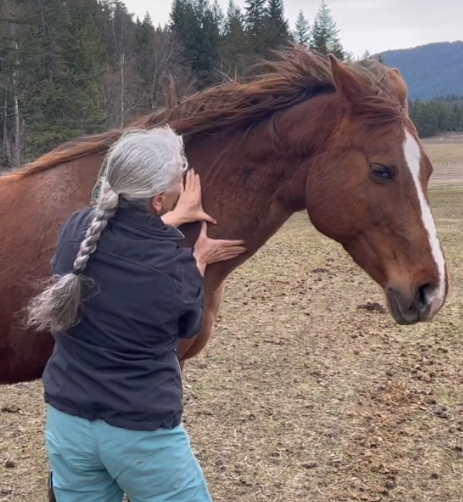
Week 2
Flowing walk. Heel-first landings.
First walk sessions introduced. Heel-first landings beginning to appear consistently. Spine noticeably lengthened. The movement quality transformation is already visible.
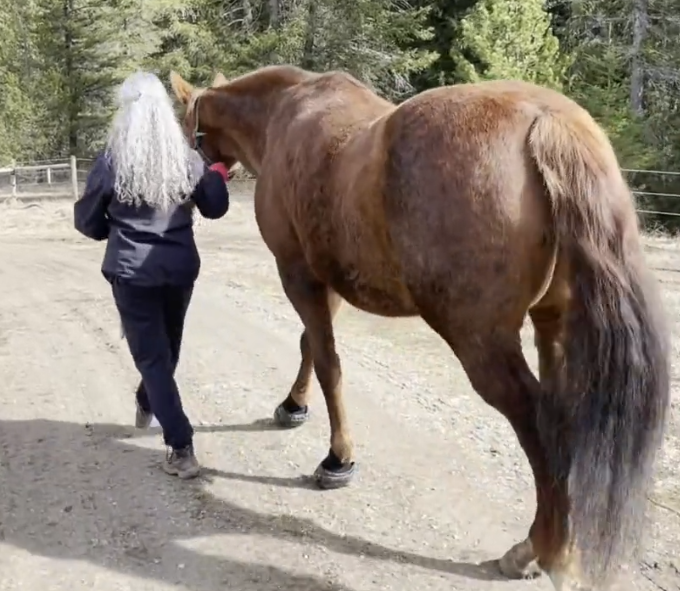
Month 1
Self-carriage emerging. Fully functional movement.
Swinging, flowing movement. Heel-first landings consistent. Engaged spine. Self-carriage beginning to develop.
This horse had severe laminitis.
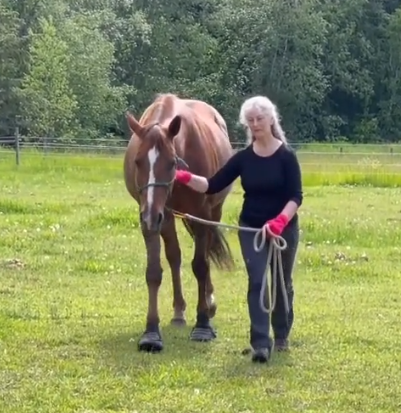
See it for yourself.
Watch from 0:38 — the swinging, flowing movement. The heel-first landings. The engaged spine.
Not just "sound enough." Not just "getting by."
Fully functional, biomechanically correct movement.
What to expect for your horse:
| Days | Improved attitude — your horse begins to communicate differently |
| 1–2 weeks | Better movement quality — visible changes in how they carry themselves |
| 2–4 weeks | Flowing walk — heel-first landings becoming consistent |
| 4–8 weeks | Self-carriage beginning — weight shifting off the forehand |
While the hoof continues remodeling for 6–12 months — this is normal.
The nervous system can reorganize quickly. The hoof grows slowly.
Don't wait for perfect hooves to begin movement work.The movement work helps the hooves heal correctly.
ZJ's recovery wasn't accidental. It wasn't exceptional.
It was systematic.
The same protocols are in this course. The same Movement Language approach. Applied to the specific crisis laminitis creates in the nervous system and movement patterns.
This is what becomes possible for your horse.
Inside the Course
8 Modules. 18 Lessons.
Systematic, step-by-step instruction. Video demonstrations of every protocol. Evaluation criteria throughout.
Module 1 — Why This Course Exists
The gap in conventional laminitis protocols. What nervous system rewiring means for your horse's recovery. Why movement pattern recovery is the missing piece.
Module 2 — Foundation
Diet, trim, and what must be in place before beginning. How to know when your horse is stable enough to start. Cryotherapy, pain medication protocols, and readiness criteria.
Module 3 — Develop Your Eye
The 13 Key Moments. How to film your horse for assessment. What functional movement looks like vs. compensation. Weekly video protocol.
Module 4 — Develop Your Feel
Readiness assessment. How to evaluate your horse's response to movement. The difference between discomfort and progress. Evaluation criteria for every stage.
Core Module
Module 5 — Lengthen Your Horse's Spine
The Triad. At-rest protocols. Early walk sessions. Progressive spine-lengthening sequences. This is where functional movement is rebuilt — systematically, step by step.
Module 6 — Improve Your Horse's Balance
Progressive balance protocols. Hind limb tracking. Developing self-carriage. The transition from recovery movement to full function.
Module 7 — Moving Forward as Your Horse Recovers
How to know when your horse is ready for more. Long-term movement maintenance. Recurrence prevention. When you can return to riding or full work.
Module 8 — Bonus Resources
Abscess care during recovery. Additional case studies. Complete FAQ and troubleshooting guide. Answers to every common challenge you'll encounter.
✓ Video demonstrations of every protocol
✓ Systematic evaluation criteria so you always know if it's working
✓ Complete troubleshooting for every challenge
✓ Work at your own pace
The Investment
Movement Recovery After Laminitis
$697
✓ Complete 4-step movement recovery system
✓ 8 modules, 18 comprehensive lessons
✓ Video demonstrations of every protocol
✓ Systematic evaluation criteria throughout
✓ Complete troubleshooting for every challenge
One-time payment. Immediate access upon enrollment.
I'm confident in these protocols because I've watched them work for 40 years. If you do this work consistently, your horse will respond. That's not a guarantee — it's the nature of how horses and movement work.
This is serious work for serious horse owners.
Enroll Now →Immediate access upon enrollment
Your Guide
About Chris Adderson
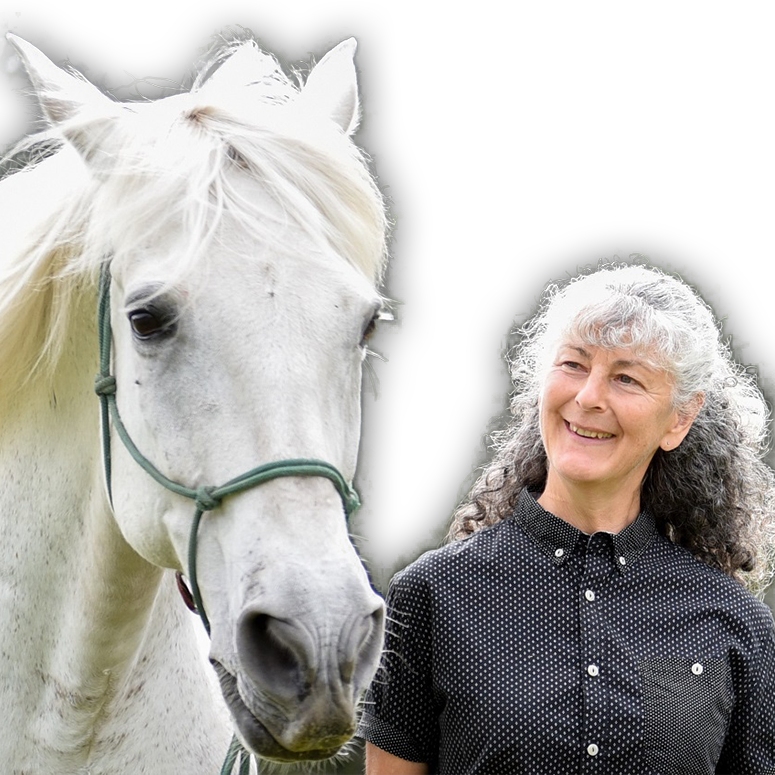
I created Movement Language because classical dressage and kinesiology gave me two things most horse educators don't have together: a deep understanding of how bodies move, and a deep understanding of how horses communicate.
That combination is why this course exists — and why it works.
I kept seeing the same thing: horse owners doing everything right — perfect diet, expert trimming, ideal management — and their horses still weren't moving correctly after laminitis.
The conventional protocols were healing the structure but not recovering the function. There was a gap. A missing protocol. This course fills that gap.
The protocols work because they're based on how horses actually communicate and move. Not mechanical aids. Not force-based methods.
Movement Language — the embodied communication system horses use with each other naturally. When you speak your horse's language, everything changes.
B.Kinesiology, University of Calgary
40+ years with horses
Professional dance training
Creator of Movement Language
Creator of Patterns of Reciprocity™
Author: Going Beyond
Shining World Compassion Award
Common Questions
How soon after laminitis can I start?
Once your horse is stabilized—off pain medication for 48+ hours, comfortable standing and moving minimally, diet addressed, basic trim in place—you can begin. Always work with your vet to confirm your horse is ready.
My horse is still landing toe-first. Can I start?
If your horse is consistently landing toe-first, focus on At Rest work first (developing your feel, releasing tension). Wait to begin walk sessions until you see at least occasional heel-first landings. The course teaches you how to evaluate readiness.
How long does recovery take?
Movement function returns faster than structural healing. Most horses show improved attitude in days, better movement quality in 1–2 weeks, flowing walk in 2–4 weeks, and self-carriage beginning in 4–8 weeks—while the hoof continues remodeling for 6–12 months. Every horse is different.
Do I need special equipment?
Essential: Hoof boots with pads (for protection during work sessions) and a soft, forgiving surface to work on.
Helpful but not required: Video recording device for weekly documentation. The course provides specific recommendations.
Can I do this if my horse is shod?
The protocols are designed for barefoot rehabilitation with boots for protection during sessions. Research by Dr. Robert Bowker shows metal shoes interfere with proprioception (your horse's ability to feel their feet), reducing the sensory feedback needed for movement recovery. If your horse is shod, work with your farrier to transition to barefoot with boots.
What if I don't see progress?
The course includes systematic evaluation checkpoints and complete troubleshooting protocols. Common reasons for lack of progress—all addressed in the course—include diet not strict enough, trim needs adjustment, working too much or too little, horse falling into dysfunction in turnout, or abscess developing. Plus, if you require personalized feedback, just send up an email and we can set that up for you.
Will this work for chronic laminitis (years ago)?
Yes. Many horses compensate for old laminitis damage with dysfunctional movement patterns, leading to secondary lameness. The protocols help identify remaining dysfunction, release compensatory patterns, and establish correct movement—even years after the initial episode.
Can I ride during recovery?
Not initially. Wait until spine lengthening is fully established, flowing heel-first walk is consistent, you've begun work on The Lift, and your vet and farrier agree. Then start with very short sessions (5–10 minutes), walk only, on soft footing, with boots. The course provides guidance on when and how to return to riding safely.
The Cost of Waiting
Movement pattern compensation doesn't stay stable. It compounds.
• Dysfunctional patterns become harder to change with every passing month
• Secondary issues develop — suspensory damage, navicular changes, arthritis
• Recurrence risk increases when movement quality remains poor
• The window for optimal recovery narrows
• Years pass with stilted, limited movement when full function was possible
The recurrence rate for laminitis is 34%.
If movement patterns aren't corrected, the cycle is likely to repeat.
Your horse's nervous system is ready to reorganize around health.
It needs your guidance to do it.
"
It felt like there was a grounded current running through my mare and I, like we were sharing the same pulse.
There were no big reactions — we simply responded to each other with every tiny movement.
Today's ride felt like... Home. 
Elissa
Movement Language Student
Your Horse Is Ready.
They've survived the crisis. They've been waiting for someone to speak their language. This is how you do it.
✓ 8 modules, 18 lessons
✓ Video demonstrations of every protocol
✓ Systematic evaluation criteria throughout
✓ Complete troubleshooting for every challenge
$697
USD • One-time payment • Immediate access
Enroll Now →Immediate access upon enrollment
If you've watched my YouTube videos on laminitis recovery, you've asked for this course. It's here.
Everything I've learned in 40 years working with laminitic horses — distilled into a systematic, owner-implemented protocol.
The same protocols that recovered ZJ (you've seen her in the videos). The same Movement Language approach that's transformed thousands of horses across every discipline. Now applied specifically to the crisis you're facing.
Your horse survived. Now help them truly recover.
With care for your horse,
Chris Adderson
Creator of Movement Language & Patterns of Reciprocity™
P.S. The recurrence rate for endocrinopathic laminitis is 34%. Horses that have had laminitis are at significantly higher risk of having it again.
Movement quality is one of the most important factors in reducing that risk. A horse who moves well — heel-first, with an engaged spine and functional balance — is a horse whose body is working correctly. A horse who moves in chronic compensation is a horse whose physiology remains stressed.
This isn't just about recovering from the last episode. It's about protecting your horse from the next one.
Enroll in Movement Recovery After Laminitis — $697 →